A Word from President Krishna Komanduri, MD
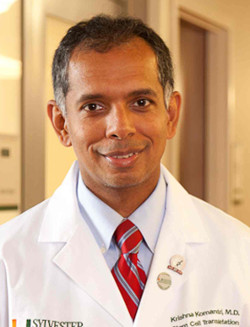
Dear colleagues,
While there is much ASBMT news to report, I’m going to deviate from the usual business of speaking about Society priorities and accomplishments in this column. The reason for that is that the last several weeks have been anything but ordinary.
I am writing this at the end of September, which has been an unexpectedly tumultuous month. Two months ago I wrote about storm clouds, but could not have imagined when I wrote about my visit to the National Hurricane Center that Miami would soon be in the sights of a potentially fearsome storm. Just weeks after the torrential rains and catastrophic flooding in Houston, much of Florida saw itself in the path of a Category 5 hurricane. As Irma intensified and seemed to lock its sights onto South Florida, our program and our staff braced for both the clinical and personal impacts of the storm. Many, like my family, who resided in mandatory evacuation zones, faced anticipatory school closings and were forced to flee our homes due to the threats from wind and possible storm surge. Given that our life’s work is caring for the sick at their most vulnerable, others knew that their families would have to be without them during a difficult time as they stayed at the bedside providing patient care.
By the time the storm made landfall, the eye had veered west (as a reminder about the still significant limitations of even the most sophisticated big data predictions) and Miami was hit by “just” category 1 and 2 sustained winds. Still, the devastation was significant, though fortunately mostly to trees, fences and power lines rather than critical structures like buildings and houses. Furthermore, the path of impact was wide given the immense size of the storm, and most of the residents of our region lost power; at our house we lost all cellular phone service and even wired internet services. Three weeks later, life has (mostly) returned to normal, albeit punctuated by the persistent sounds of chainsaws and with maimed trees, dramatically decreased shade canopies and large piles of browning debris serving as stark reminders of what we faced not long ago.
Still, this experience was not entirely negative. The storm served as a reminder of how fortunate we are to be members of a genuinely special community. I cannot count the number of heartfelt messages I received from ASBMT friends and colleagues who reached out. Many offered not only their sincere concern but even refuge in their own homes. Several medical directors of transplant programs contacted me in advance expressing concern about our patients and offering patient care assistance if our unit became impossible to occupy after the storm. Fortunately, our inpatients remained entirely well thanks to the incredible efforts by dedicated members of “ride-out” teams, who willingly stayed with transplant recipients rather than their own family members.
Our medical school and hospital administrators took the remarkable step to house family members of staff who could not evacuate, including pets who could not be left alone in the uncertainty of the storm. Even after our medical school ceased normal clinical operations, our transplant staff continued to voluntarily work to operate scaled down emergency clinics and to finish collections on patients and donors who had already started mobilization. All of this proved inspiring and uplifting to me and to our deserving and vulnerable patients.
While their conduct was nothing less than remarkable, the challenges faced by the staff of our stem cell transplant program paled in comparison to those faced by patients who were about to undergo or had recently received transplants. As I could not help but consider the needs of my own family, the importance of community and support for our patients came into sharp relief. The complexity of the pre-transplant process (from donor selection in the allogeneic setting to mobilization and collection in our autologous recipients) was dramatically increased by our inability to operate normal clinics, perform apheresis and obtain unrelated donor products with roads and airports closed or inaccessible. Despite challenges, we came together as a team and kept everyone safe.
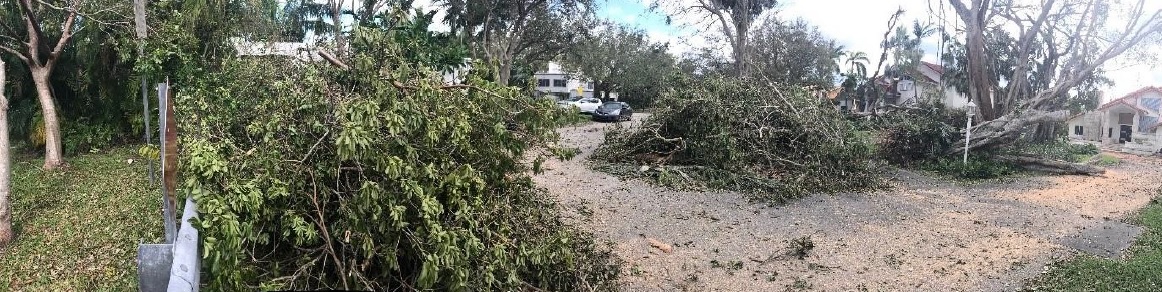 Irma’s aftermath, Palmetto, Florida
Most of us take for granted continuous mobile communications, internet access, the availability of 24 hour pharmacies, weekend clinics, near-immediate blood product availability and other realities that did not exist in most of South Florida communities for over a week. Irma (and Harvey before her) should remind us all that the least fortunate of our patients cannot take any of these factors for granted even in fair weather, due to limitations in finances, transportation or caregiver access. Despite the unpleasantness of the past weeks, what most of us faced is nothing like the silent struggles of our patients and their loved ones.
These recent experiences reaffirm for me how lucky we are to be part of such a special community—dedicated not only to the care of our vulnerable patients, but to each other. Those of us in Houston and Miami will tell all of you to take life a bit less for granted, to review and polish your disaster plans and (most importantly) to give extra thanks for the well-being of your family and your co-workers. I am so grateful all of you were there for me, my colleagues and our patients. Those of us affected sincerely hope we don’t have to return the favor any time soon, but know that we will if ever needed. I am so proud and thankful to help govern a society so ingrained with camaraderie and altruism.
Until next month, I wish all of you clear skies and happy days!
Krishna
Read the entire October 2017 ASBMT eNews here.